Diddy baby oil became a widely searched phrase after reporting about federal searches tied to Sean Combs mentioned baby oil among other items. The phrase spread fast because the detail was unusual and easy to repeat. It was then turned into jokes, memes, and shorthand for a much larger story. It should not be treated as a formal case name or legal finding.
This summary stays focused on the baby oil topic itself. It separates three different layers: confirmed reporting, legal allegations, and social media speculation. That distinction matters because the phrase often traveled online without its original context. A clear reading depends on knowing what was actually reported and what was added later.
What the phrase means
Diddy baby oil is an informal label, not an official legal term. It points to reporting that mentioned baby oil in connection with searches at properties tied to Sean Combs, also known as Diddy. Once that detail entered the news cycle, people began using it as shorthand for the wider controversy. The phrase stuck because it was short, memorable, and unusual.
The product itself is ordinary. What made it notable was the setting in which it was reported. In major celebrity stories, a small detail can become a symbol for the entire news event. That is what happened here, especially after social media users started repeating the phrase on its own.
For readers trying to understand the topic, the key point is simple. The phrase refers to a reported detail, not a conclusion. It does not explain the entire case, and it does not prove anything by itself.

What was reported
In March 2024, federal agents searched properties associated with Sean Combs as part of an investigation reported by multiple news organizations. Coverage of those searches included references to baby oil and other items said to have been seen or recovered during the searches. Those reports are the source of the viral phrase.
This is an important distinction. Reporting that an item was mentioned during a search is not the same thing as proving criminal wrongdoing. It is also not the same thing as a court ruling. News coverage can accurately describe what investigators did or what sources said without settling the meaning of every item involved.
The baby oil detail drew attention because it was unexpected. Many other parts of the reporting were more serious, but less memorable online. That is often how viral phrases work. A small detail becomes the headline people remember, even when it is not the most important part of the story.
Some headlines and clips isolated the baby oil reference, which helped the phrase spread. That also made it easier for readers to assume more than the reporting supported. To read the story carefully, it helps to ask whether the claim came from direct reporting, an official filing, or unnamed sources.
What was alleged in the broader case
The baby oil reference appeared in the context of broader allegations and legal proceedings involving Sean Combs. Those matters included civil lawsuits and federal criminal charges in 2024. The baby oil detail is separate from those allegations, even though online discussion often blended them together.
An allegation is a claim made by a person, prosecutor, or plaintiff. It is not proof on its own. A court case can include many allegations, and each one must be considered on its own evidence. The phrase Diddy baby oil should not be used as if it were evidence of any specific accusation.
That point matters because viral discussion can make a small detail seem more revealing than it is. A reported item does not explain the whole case. It does not confirm guilt, and it does not replace the legal filings. It is only one public detail from a much larger story.
When people combine the baby oil reference with claims that were never clearly supported, confusion follows. A factual summary should keep the layers separate. It should distinguish reporting about a search, allegations made in legal cases, and speculation circulating online.

What social media added
Social media quickly turned the phrase into a meme and a joke. That online reaction is part of the story, but it is not the same as verified reporting. Once the phrase spread, many people used it to signal surprise or mockery without knowing the original reporting well.
This pattern is common. A striking detail appears in the news, then gets detached from its context and reused in posts, clips, and reaction threads. The more it is repeated, the less the original reporting matters. In that environment, a phrase can become more familiar than the facts behind it.
Some posts treated the baby oil detail as if it carried a hidden meaning that had not been publicly established. Others used it as shorthand for celebrity excess or scandal in general. Those reactions are not confirmed facts. They are examples of online interpretation.
Readers should be cautious with claims that make the detail seem more dramatic than the reporting supports. A viral phrase can travel far beyond the evidence behind it. That is especially true when the phrase is catchy, short, and attached to a highly public figure.
What is confirmed, and what is not
The confirmed part of the story is narrow. News organizations reported federal searches at properties associated with Sean Combs in March 2024, and those reports included references to baby oil among the items discussed. That reporting is the basis for the phrase.
What is not confirmed by that reporting is any larger conclusion people may draw from it. The presence of baby oil in coverage does not prove the meaning of the item or the purpose of the item. It does not, by itself, establish a criminal act. It also does not support every rumor that later appeared online.
This matters because viral coverage often folds different levels of certainty into one. A report can be accurate, a legal claim can be serious, and a social media interpretation can still be wrong. Keeping those levels separate is the safest way to read the story.
A simple rule helps here. If the claim comes from a meme, a repost, or a speculative thread, treat it as commentary unless it can be traced to a reliable source. If it comes from a news report, check whether the report explains where the information came from. If it comes from a legal filing, remember that a filing is still an allegation until a court resolves it.
Why the phrase spread so fast
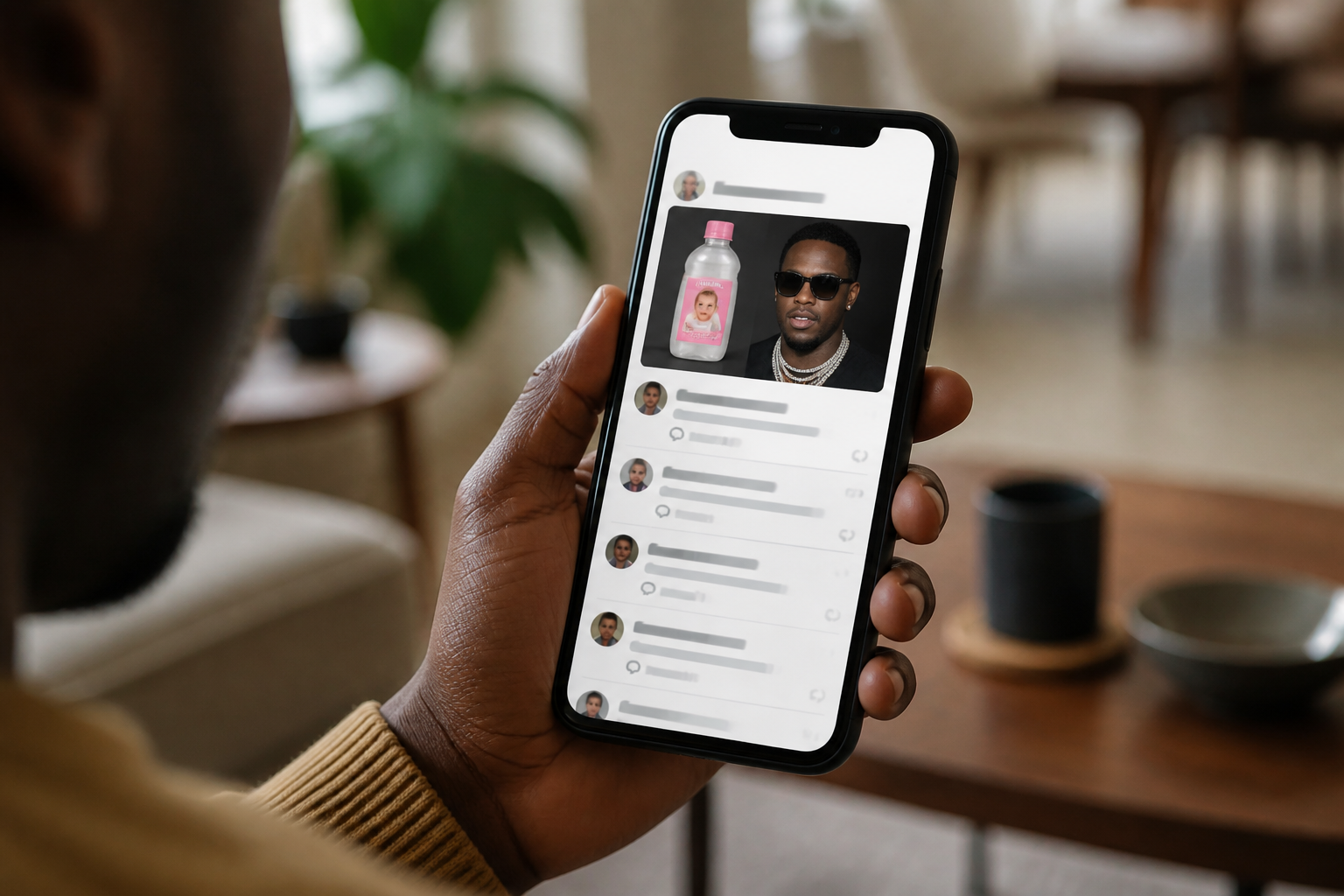
Diddy baby oil spread quickly for three basic reasons. First, it involved a famous name.
Second, it included an ordinary but surprising object. Third, it appeared during fast-moving celebrity and legal coverage. Those factors made the phrase easy to repeat.
The phrase also worked as shorthand. People could use it instead of explaining the full reporting every time. That made it efficient online, even if it was not efficient for understanding the facts. The more a phrase gets reused, the more it can stand in for the entire story.
Viral language often rewards the most memorable detail rather than the most important one. In this case, the baby oil reference stood out because it sounded unusual and was easy to turn into a joke. That combination helped it move beyond the original articles that mentioned it.
Another reason it spread is that people often search for the smallest recognizable part of a larger story. If a detail appears in headlines, clips, and commentary, it becomes the easiest entry point for readers catching up. That helps explain why the phrase kept showing up in search results and discussion feeds.
How to read coverage responsibly
The safest way to read Diddy baby oil coverage is to keep three questions in mind. What was reported?
What was alleged? What is only being repeated online? Those questions help prevent overstatement.
First, check whether the baby oil reference comes from direct reporting or from a post summarizing a report. Second, ask whether the item is being used as evidence, as a joke, or as a symbol. Third, remember that unusual details can be true without being central to the case.
Readers should also be careful about language that sounds more certain than the evidence allows. Phrases like “this proves” or “this means” often create confusion. Clear reporting can simply state what was found, what was said, and what remains unproven.
That approach is especially useful in celebrity coverage. High-profile names attract attention, and attention can blur the line between verified information and online interpretation. A short, factual summary is usually better than a dramatic one.

Why the phrase became so widely discussed
Diddy baby oil became widely discussed because it condensed a complicated news cycle into a single memorable label. It was easy to repeat, easy to search, and easy to turn into a joke. At the same time, it pointed back to real reporting tied to a serious investigation, which gave the phrase staying power.
That combination made it especially sticky. A phrase that is both funny and connected to real reporting can move quickly online. People who never read the full coverage may still recognize it because it traveled through headlines, memes, and commentary together.
The broader reason it lasted is that the internet prefers symbols. A small object can become a symbol for an entire story, even when the object itself is only a minor part of the reporting. In this case, baby oil became a symbol because it was memorable and because the public was already following a larger controversy around Sean Combs.
For that reason, the phrase should be understood as media shorthand, not as a standalone fact. The reporting behind it involved searches, allegations, and public reaction. The viral phrase itself came from how those pieces were compressed and circulated online.
Short takeaway
The simple answer is that Diddy baby oil went viral because a small detail from reporting about federal searches tied to Sean Combs was repeated online until it became a meme. The confirmed part is the reporting itself. The allegations belong to the broader legal cases. The jokes, guesses, and exaggerated claims belong to social media.
That is why the phrase spread so widely. It was unusual, memorable, and tied to a high-profile story. But the phrase is only a label. To understand it accurately, readers need to keep reporting, allegations, and rumor separate.

How David Bowie Reinvented Himself and Changed Music Forever

David Bowie made reinvention part of his artistic identity, and popular music has never quite looked the same. Across five decades, he treated image, sound, and performance as connected pieces of one creative vision. That approach made him one of the clearest examples of how a single artist could reshape an era without staying in one place for long.




Comments 0